Best Buy, Worst Thinking

By Steve Milloy
July 30, 2010, Worthington Daily Globe (Minnesota)

When it comes to energy policy, no one can accuse Best Buy’s management of best thinking.

As Sen. Harry Reid scrambles to pull together some sort of energy bill before time runs out in this Congress, the cap-and-trade advocacy group Business for Innovative Climate and Energy Policy (BICEP) is lobbying Reid to include in the bill an “energy efficiency resource standard” (EERS) that would reduce electricity use by one percent in 2012 and more by 2020.

Although EERS is a dubious proposition for all BICEP’s members — including the Aspen Skiing Company, eBay, Levi Strauss, Nike and Target — Best Buy’s support makes one wonder what’s in the air at corporate headquarters.

As a retailer of electronics and appliances, every Best Buy product depends on the use of electricity. While electronics and appliances are continually becoming more energy efficient, that doesn’t mean they (or those who use them) use less electricity.

When television sets were upgraded from old tube technology to larger LCD and plasma models, for example, TV energy use increased by anywhere from 100 to 500 percent. Even if newer LCD and plasma models meet government Energy Star standards of using 30 percent less energy than standard units, they still will use substantially more electricity than the older technology.

Similarly, a new refrigerator may be more efficient than an older model, but if it’s larger and has more bells and whistles, then it’s more probably using more energy. Moreover, the American lifestyle is becoming more, not less, dependent on electricity. Past the proliferation and increased use of all sorts of devices from cell phones to personal computers to electronic games, Americans are now turning to electronic book readers like the Kindle and iPad.

Add into the mix the push for electric vehicles, and the notion that there’ll be less need for electricity becomes even more absurd. The only way to use less electricity is to buy and use fewer and smaller gadgets, appliances and other consumer goods. It’s hard to see how these trends will bring any benefits to Best Buy’s bottom line.

Additionally, the question must be asked: Why should Americans want to use less electricity? What would be the economic impact of reduced electricity use?

As the National Academy of Sciences pointed out in its landmark report, “Electricity in Economic Growth (1986), “Electricity use and gross national product have been, and will probably continue to be, strongly correlated.” This truth of this relationship continues to exist — the economy is struggling and electricity use is down. More generally, there probably never has been a time in human history when social and economic advancement has occurred without increased use of energy.

In other words — and for the benefit of Best Buy’s management — if the goal is to have consumers that can continually afford to indulge in the latest electronic gadgetry, two things must happen — increased economic growth and available and affordable electricity.

Best Buy and the BICEP coalition, however, seem to be in favor of neither scenario — not so surprising given BICEP’s provenance. BICEP is the brainchild of Ceres, a environmental activist organization dedicated to co-opting business to the political left’s fight against capitalism and free enterprise. BICEP’s mission is to provide Congress and the public with the impression that U.S. business is demanding cap-and-trade and its corollary, renewable energy welfare programs.

For a company like Best Buy, BICEP is the old morally superior public relations ploy. Unlike, in their estimation, those they preach to, the BICEP companies care about the planet. In the end, BICEP’s precepts are simply bone-headed. Poor people can’t afford plasmas or (pay attention NIKE) $140 LeBron VIIs.

Steve Milloy publishes JunkScience.com and is the author of “Green Hell: How Environmentalists Plan to Control Your Life and What You Can Do to Stop Them” (Regnery 2009).
Should Steve Jobs make Al Gore take a leave of absence?

Now that the Portland, OR police department has re-opened its sex attack investigation against Al “You-big-lummox-of-a-sex-poodle” Gore, should Apple Chariman Steve Jobs make Al Gore take a leave of absence from the company pending resolution of the investigation?

Apple’s sexual harassment policy defines harassment as…

<blockquote… unwelcome or unsolicited speech or conduct based on factors such as race, color, age, sex, or sexual orientation. It may include activities such as viewing sexually explicit sites or displaying an inappropriate calendar. It may include unwelcome touching or advances, jokes, slurs, and other offensive behavior. [Emphasis added]

While the policy also says that it only applies to,

… interactions with employees, customers, suppliers, and applicants for employment and any other interactions where you represent Apple…

… surely the policy doesn’t mean that it’s open season for board members when it comes to the rest of the public. Or does it?

If Gore is cleared, he can always be reinstated.

Former GE CEO opposes climate-energy bill

Former GE CEO Jack Welch said today on CNBC that:

1. Obama should be focusing on the gulf oil spill “not new energy plans”; and

2. Our “pretty good economy” should not be “damaged” with “carbon taxes.”

“Let’s get [the economy] going,” he said.

Ironically, GE CEO Jeff Immelt and other USCAP CEOs will be pushing the climate bill on Capitol Hill tomorrow at a luncheon prior to the Democratic caucus meeting.

Welch built GE into the largest and most valuable company in the world. Immelt, in contrast, brought GE to the verge of bankruptcy, requiring a $140 billion federal bailout.

Click to watch the three-minute CNBC clip.

Sen. Boxer condemns JunkScience’s ‘Carbon Criminal’ posters

Watch Sen. Barbara Boxer condemn JunkScience.com’s Carbon Criminal posters in her Dec. 14, 2009 press conference for her remarks on the COP-15 meeting in Copenhagen.

Global cooling hurts Duke Energy

It seems as if Duke Energy CEO Jim Rogers should be lobbying for increased greenhouse gas emissions.

Rogers is convinced — because his grandchildren told him so — that carbon dioxide emissions are warming the planet. So Rogers helped form the U.S. Climate Action Partnership, a coalition of a few big businesses and environmental groups that lobbies for carbon caps.

Ironically, the very global cooling that Rogers seems to be for is actually hurting his company’s earnings.

According to Duke’s the third quarter earnings report, earnings-before-interest-and-tax (EBIT) for Duke’s electric and gas division decreased:

  • $46 million because of unfavorable weather (i.e, a cooler summer);
  • $22 million because of reduced industrial demand (i.e., weak economy); and
  • $27 million because of the expiration of a temporary rate raise (i.e., government granted windfall).

All very interesting since Rogers wants to:

But for the three factors mentioned above, USFE&G’s Q3 EBIT would have increased by 11%.

Finally, Duke has spent about $10 million since 2008 lobbying for carbon caps. That’s a lot of lost earnings itself spent working against the interests of Duke shareholders and customers.

Hey Jim, there’s a reason children aren’t allowed to run the world.

Exelon CEO bobbleheaded at Senate hearing

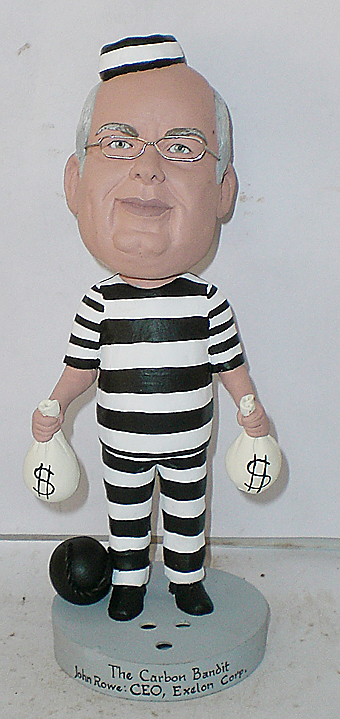
Meet Exelon CEO John Rowe…

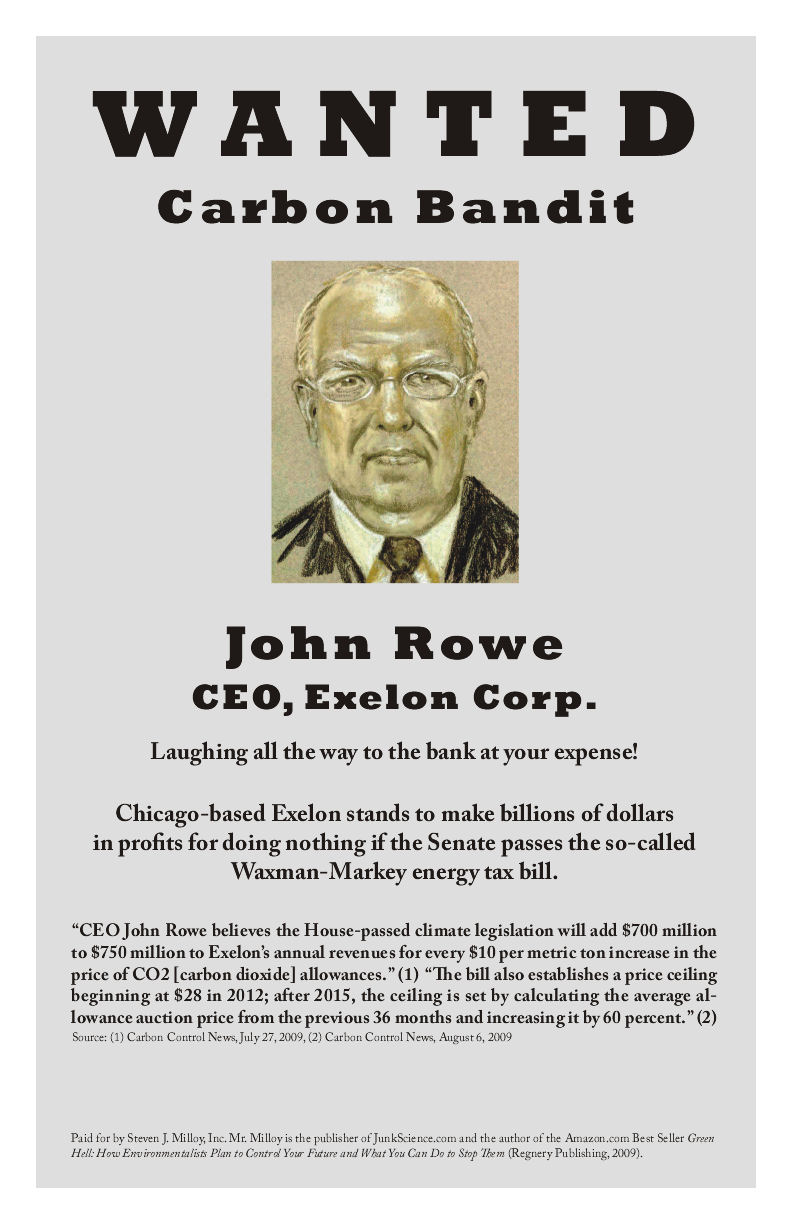
John Rowe is the “Carbon Bandit.”

Wanted Poster Exelon Sketch Final

Here’s his JunkScience.com-commissioned bobblehead…

Rowe Bobblehead 092309

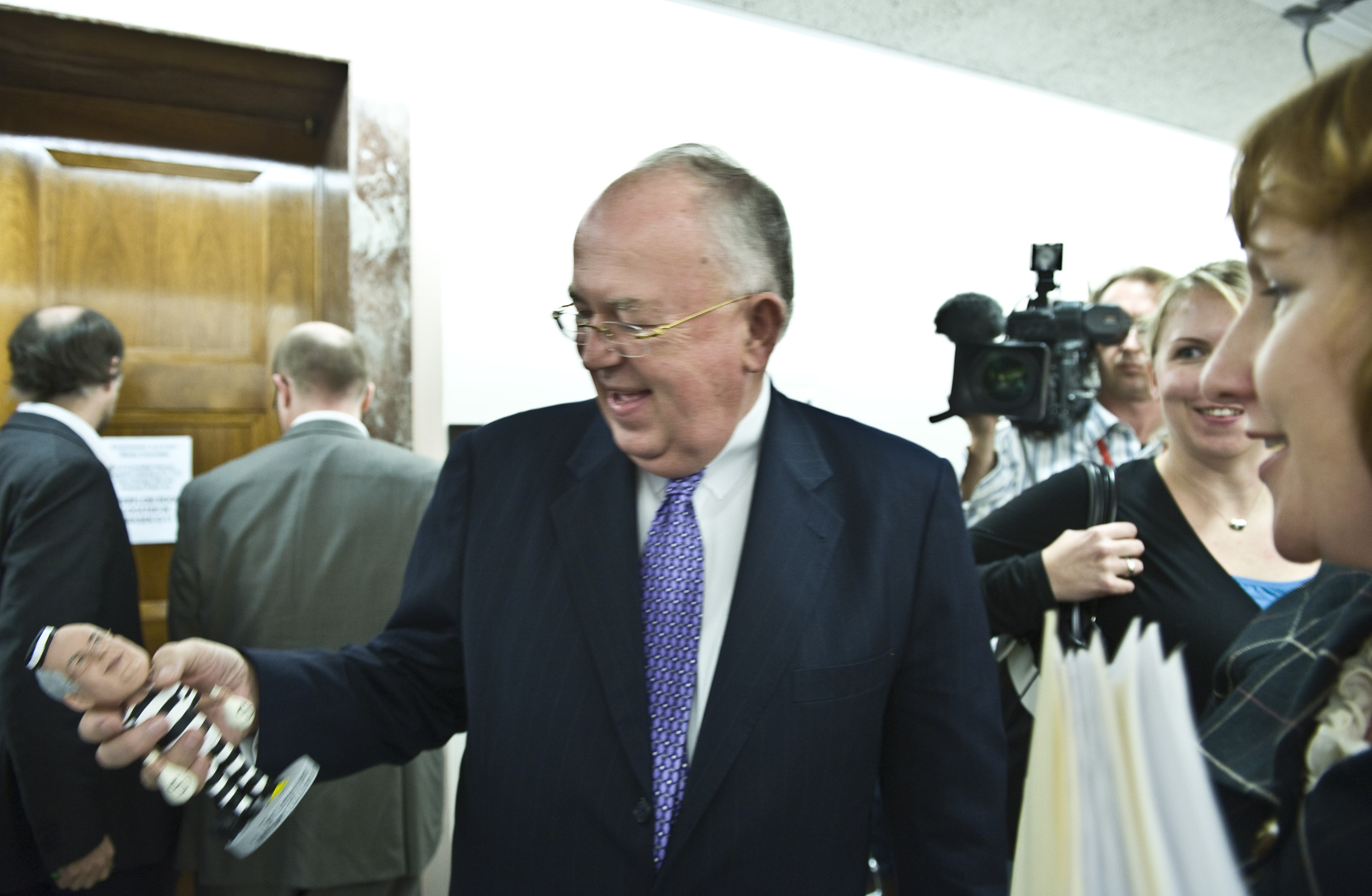
… and here’s the bobblehead being presented to his Rowe at last week’s Senate hearing on Kerry-Boxer:

Rowe gets bobblehead


Will the real John Rowe please stand up… or at least stop rent-seeking?

Levis. Original jeans. Original hypocrisy.

Levi Strauss & Co. is so worried about CO2 emissions that it quit the U.S. Chamber of Commerce in protest over the Chamber’s opposition to climate legislation.

But if Levi Strauss were really concerned about CO2 levels, it would also go out of business.

According to the company’s own analysis, a typical pair of the company’s jeans is responsible for about:

  • 70 pounds of CO2 emissions;
  • 750 gallons of water use; and
  • 111 kilowatt-hours of electricity use.

About 450 million pairs of jeans are sold in the U.S. annually. Of this amount, about one-third are sold by Levi Strauss.

Simple math indicates, therefore, that Levi Strauss annual sales of jeans are responsible for about:

  • 7.5 million tons CO2 emissions — equal to the annual emissions of 625,000 SUVs;
  • 112 billion gallons of water use — about the annual water use of 879,000 homes; and
  • 1.67 gigawatt-hours of electricity use — about the annual use of 150,000 average homes.

To help Levi Strauss save the planet, then, the answer is clear: we should go naked and it should go broke.

USCAP appeasement not working for BP

At the urging of the Natural Resources Defense Council, the Obama administration is throwing up roadblocks to BP’s upgrading of a large refinery in northwest Indiana.

Ironically, BP and NRDC are both members of the U.S. Climate Action Partnership (USCAP) that is lobbying for global warming legislation.

We’d call the NRDC a bunch of backstabbers, but then again, BP walked face-first into this one.

Problems at USCAP?

Today’s Washington Post features a full-page ad urging the Senate to adopt carbon caps this year — ironically, an ad that may signal the demise of the U.S. Climate Action Partnership (USCAP), the coalition of rentseeking big businesses and socialist activist groups lobbying for global warming regulation.

The ad is signed by 22 companies and 6 green groups.

While 15 of the ad’s signatories are USCAP members (Boston Scientific, Dow, Duke, Dupont, Environmental Defense, Exelon, GE, Johnson & Johnson, NRDC, Nature Conservancy, NRG energy, Pew Center, PG&E PNM Resources, Rio Tinto, and Word Resources Institute), 15 other USCAP members didn’t endorse the ad (AES, Alcoa, Alston, BP America, Caterpillar, Chrysler, ConocoPhillips, Deere, Ford, FPL, GM, Pepsico, Shell & Siemens).

It’s hard to believe that the ad wasn’t shopped to all USCAP members — who could have endorsed it at no cost. The ad states,

“This ad is paid for and/or supported by the aforementioned organizations.”

“Or supported” means that some signatories were not charged to participate.

It’s not surprising that Caterpillar and ConocoPhillips didn’t endorse the ad since they opposed Waxman-Markey, albeit at the last moment. But it is notable, for example, that natural gas producer BP America and free-allowance-seeking FPL didn’t sign on.

While some companies are leaving the U.S. Chamber of Commerce over climate, the USCAP den of thieves and scoundrels may be experiencing it’s own difficulties.

If Apple was really concerned about the environment…

… it would leave China, not the U.S. Chamber of Commerce.

Apple told the U.S. Chamber of Commerce in its resignation letter:

“Apple is committed to protecting the environment and the communities we operate in around the world. We strongly object to the Chamber’s recent comments opposing the EPA’s efforts to limit greenhouse gases. We would prefer the Chamber take a more progressive stance on this critical issue and play a constructive role in addressing the climate crisis. However, because the Chamber’s position differs so sharply with Apple’s, we have decided to resign our membership effective immediately.”

So when will Apple pressure the Chinese government to adopt the Clean Air Act? Isn’t actual air pollution in China much worse than the invisible, if not debatable/mythical, problem of U.S. CO2 emissions?

We doubt that Apple has any answers to those questions as Al I-need-cap-and-trade-to-become-the-first-carbon-billionaire Gore sits on its board of directors and, no doubt, cheerled Apple’s resignation from the U.S. Chamber.

Air quality in Shenzhen, China where Apple makes iPhones.
Air quality over Apple HQ in Cuppertino, CA, where the company counts its profits made from the pollution in Shenzhen, China.

GE ‘stimulated’ by $300 million water heater rebate

Everyday seems to bring new revelations about federal stimulus money earmarked for the Obama-blessed General Electric. Yesterday it was smart meters, today’s scheme involves water heaters.

GE will be selling water heaters that, as described by SmartGridToday,

…lets utilities regulate the use by sending signals wirelessly to them from smart meters.

According to the GE press release,

Additionally, the smart appliance qualifies for Energy Star rebate programs… In July, the U.S. Department of Energy announced the availability of nearly $300 million in funding for state-run Energy Star rebate programs as part of the American Recovery and Reinvestment Act stimulus plan.

The Obama-Immelt Pact (rentseeking-for-lobbying) is corrupt enough but it’s made positively execrable by its ends — allowing the government (through regulated utilities) to control our water heaters.

Wanted Poster GE Sketch Final

GE ‘stimulated’ by $300 million water heater rebate

Everyday seems to bring new revelations about federal stimulus money earmarked for the Obama-blessed General Electric. Yesterday it was smart meters, today’s scheme involves water heaters.

GE will be selling water heaters that, as described by SmartGridToday,

…lets utilities regulate the use by sending signals wirelessly to them from smart meters.

According to the GE press release,

Additionally, the smart appliance qualifies for Energy Star rebate programs… In July, the U.S. Department of Energy announced the availability of nearly $300 million in funding for state-run Energy Star rebate programs as part of the American Recovery and Reinvestment Act stimulus plan.

The Obama-Immelt Pact (rentseeking-for-lobbying) is corrupt enough but it’s made positively execrable by its ends — allowing the government (through regulated utilities) to control our water heaters.

Wanted Poster GE Sketch Final